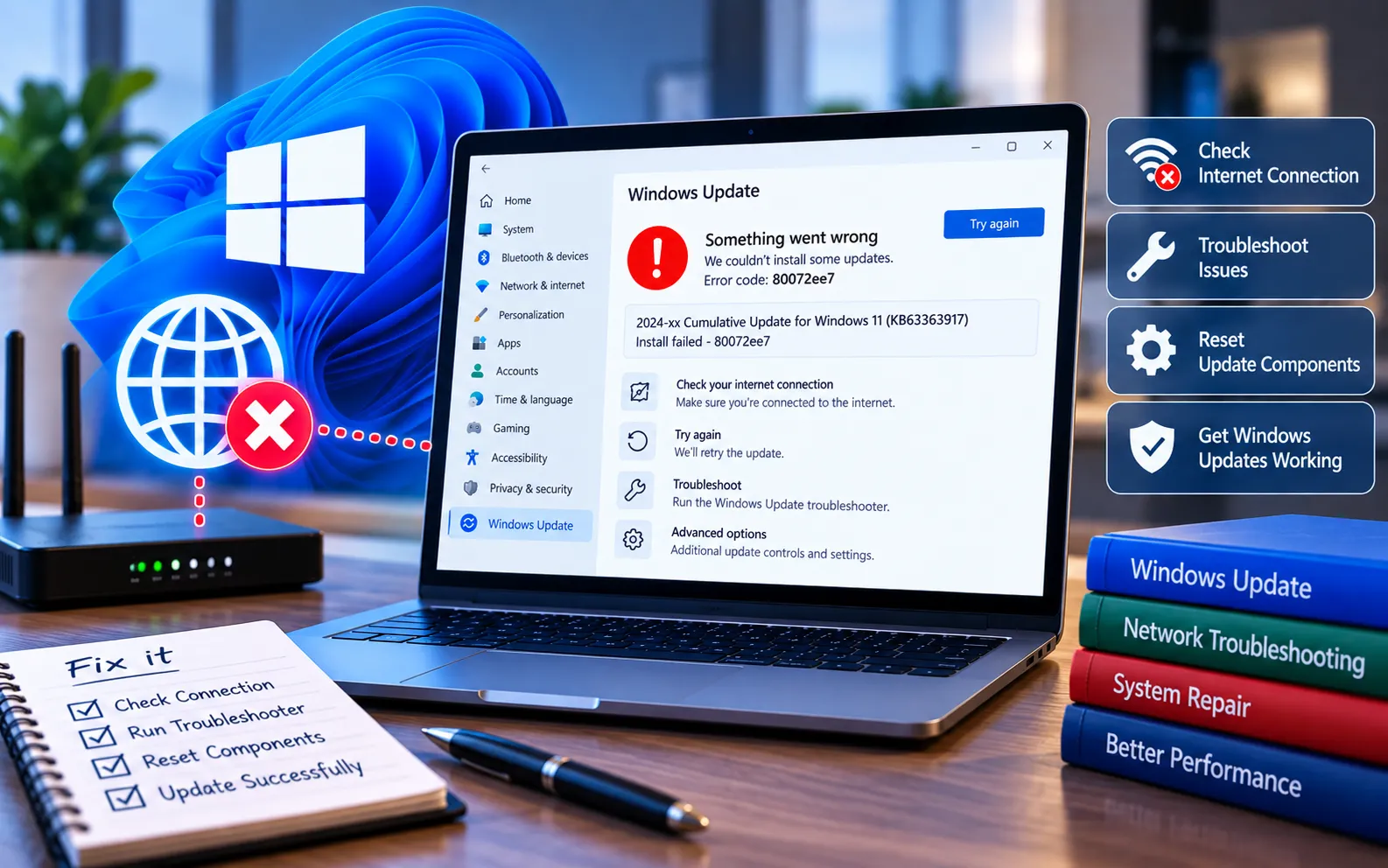
Windows Update Error Code 80072EE7 can appear when Windows 10 or 11 has trouble communicating with the update service. Network configuration, corrupted system files, security software, or damaged Windows Update components can contribute to the problem.
You can try several troubleshooting methods before resetting Windows.
What Causes Error Code 80072EE7?
Common possibilities include an unstable internet connection, incorrect network settings, firewall or antivirus interference, corrupted Windows system files, problems with Windows Update services, damaged update cache files, or incorrect system configuration. Start with the simpler solutions and move to advanced methods if the problem continues.
Here’s how to fix Error Code 80072EE7:
Check your internet connection
Restart your router, check whether other websites load normally, try connecting to another network, disable any unnecessary VPN or proxy, and restart your computer before checking for updates again. If the connection seems fine but Windows Update still reports a network-related problem, see our guide to Windows Update Error Code 0x8024402C.
Temporarily disable third-party antivirus software
Open your antivirus application, go to Settings or Protection, find Real-time protection, and turn it off temporarily. Check Windows Update again, then re-enable your antivirus after testing — don’t leave your computer without protection longer than necessary.
Run System File Checker
Right-click Start, select Terminal (Admin), and run sfc /scannow. Wait for the scan to finish and restart your computer. Then check Windows Update again.
Run DISM
If SFC doesn’t resolve the problem, open Terminal (Admin) and run each command one at a time: DISM /Online /Cleanup-Image /CheckHealth, then DISM /Online /Cleanup-Image /ScanHealth, then DISM /Online /Cleanup-Image /RestoreHealth. Restart your computer once complete. If corrupted system files continue causing update failures, see our guide to Windows Update Error Code 0x800F0900.
Run the Windows Update Troubleshooter
Windows 11: Settings → System → Troubleshoot → Other troubleshooters → Windows Update → Run.
Windows 10: Settings → Update & Security → Troubleshoot → Additional troubleshooters → Windows Update → Run the troubleshooter.
Restart your computer and check for updates again.
Check the Windows Update service
Press Win + R, type services.msc, press Enter, find “Windows Update,” double-click it, set Startup type to Automatic, click Start if it’s stopped, and click Apply then OK. Also check Background Intelligent Transfer Service (BITS) and Cryptographic Services. Restart your computer after making these changes.
Reset Windows Update components
Open Terminal (Admin) and run:
net stop wuauserv
net stop cryptSvc
net stop bits
net stop msiserver
ren C:\Windows\SoftwareDistribution SoftwareDistribution.old
ren C:\Windows\System32\catroot2 catroot2.old
net start wuauserv
net start cryptSvc
net start bits
net start msiserver
Restart your computer and check for available updates.
Try Windows Update again
Windows 11: Settings → Windows Update → Check for updates.
Windows 10: Settings → Update & Security → Windows Update → Check for updates.
If the update still fails to download, see our guide to Windows Update Error Code 0x8024A206.
Reset Windows as a Last Resort
If none of the previous solutions work, back up your important documents, photos, and other personal files first, then use Settings → System → Recovery → Reset PC on Windows 11, or Settings → Update & Security → Recovery → Reset this PC → Get started on Windows 10. This should be your final option, since applications and settings may be removed. Our experts are here to assist you — Chat with a specialist — for more technical support.
We are an independent technical support provider and are not affiliated with, endorsed by, or sponsored by Microsoft.
FAQ
What does Error Code 80072EE7 mean?
It generally appears when Windows has trouble communicating with the service required to complete an update — network configuration and Windows Update problems can contribute.
Can SFC fix Error 80072EE7?
SFC can repair certain corrupted system files that may interfere with Windows Update. If it doesn’t resolve the problem, DISM is another useful repair tool.
Should I disable my antivirus permanently?
No. Temporarily disable third-party security protection only for troubleshooting, and re-enable it after testing Windows Update.
Do I need to reset Windows?
Usually not. Check your network connection, run SFC and DISM, verify Windows Update services, and reset the update components first.
Tags: Error Code 80072ee7, KB63363917, Windows Update Error Code 80072ee7
